Threshold: Where Form Becomes Life
When does a form stop being made, and begin to behave?
This essay explores the threshold where clay is no longer read as surface alone, but as something that suggests life—through repetition, accumulation, and material response.
There is a moment in the making where the material shifts.
It is not immediate, nor is it predictable. It arrives slowly, often without announcement—somewhere between the first gesture and the final firing. A surface that was once clearly formed by hand begins to resist that reading. It no longer presents as object alone. It begins to suggest something other: a presence, a system, a quiet kind of life.
This is the threshold.
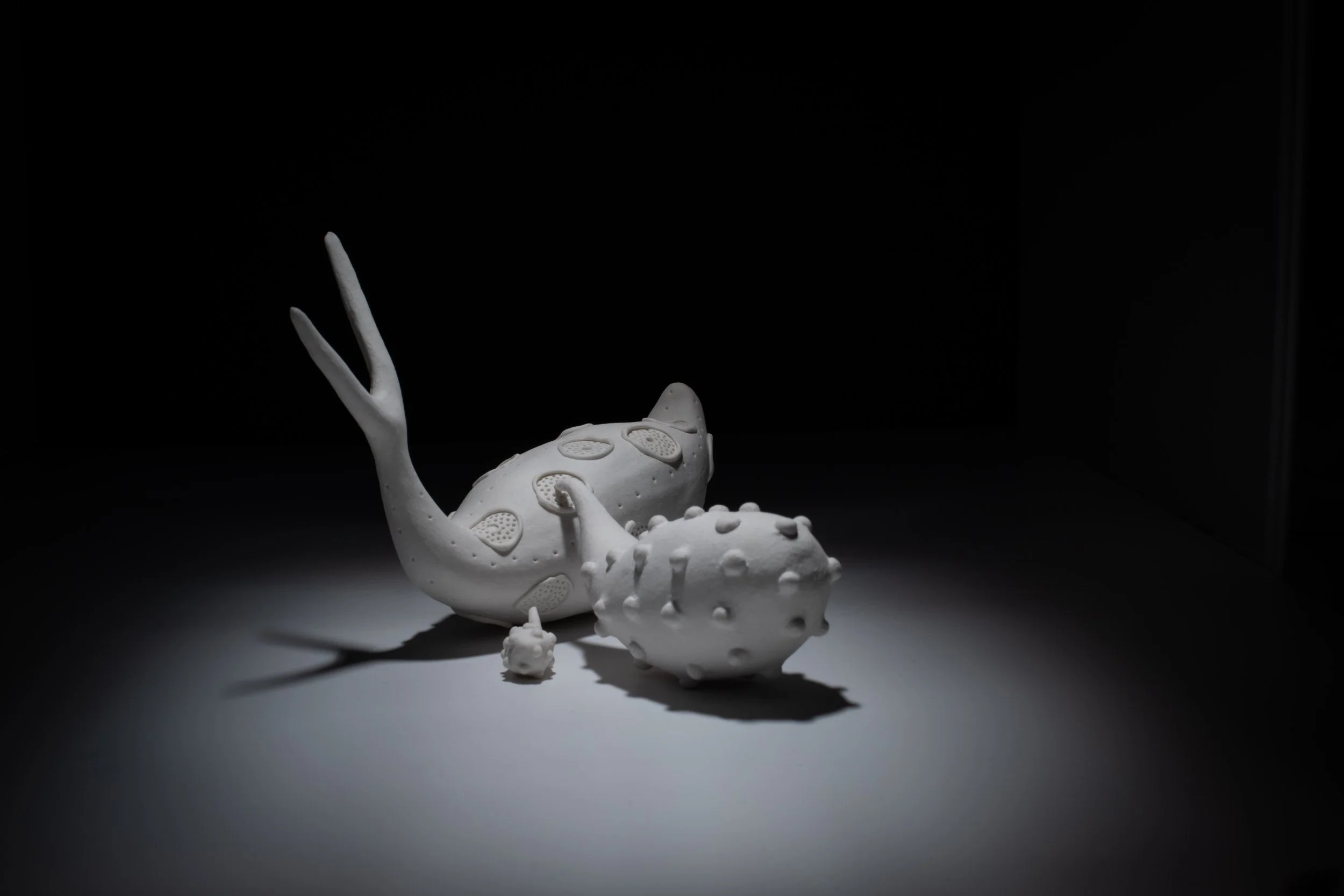
In my practice, this threshold is not something I impose, but something I work toward through attention. Clay remains clay—porcelain, stoneware, slip—but through repetition, accumulation, and surface behaviour, it begins to take on qualities that feel familiar to the living world. A crawling glaze edges outward like lichen finding hold on stone. Slip dots gather and disperse across a surface, echoing propagation, growth, or spore. Marks repeat, not as decoration, but as a way of building a system—something that reads less as singular gesture and more as quiet activity over time.
At a certain point, the work shifts. It is no longer simply made; it begins to behave.
This is not a claim of animation, nor a desire to replicate nature. The works are not imitations of specific organisms, but responses to the conditions under which life operates—adaptation, persistence, colonisation, repair. They sit somewhere between recognition and abstraction, where a viewer may sense the logic of a living system without needing to name it.
The threshold is completed in perception.
A viewer leans closer. The eye adjusts. What was first encountered as surface becomes something more complex—something that invites attention rather than receives it passively. In this moment, the work is not transformed physically, but perceptually. It is read differently. It is held differently. The boundary between object and organism softens, even if only briefly.
This matters.
In a time where many of the systems that sustain life are overlooked or diminished, our ability to recognise life—particularly in its quieter, less visible forms—has been dulled. Lichens, mosses, fungal networks: these are not spectacular in scale, but they are foundational. They build, break down, connect, and renew. They operate slowly, often beyond immediate notice, yet they are essential to the health of the environments they inhabit.
To work at the threshold is to return attention to these modes of being.
It is to slow the encounter. To ask for a different kind of looking—one that is patient, close, and willing to remain with uncertainty. Not everything resolves quickly. Not everything needs to be named. There is value in the pause, in the moment where something is not fully understood but is still felt.
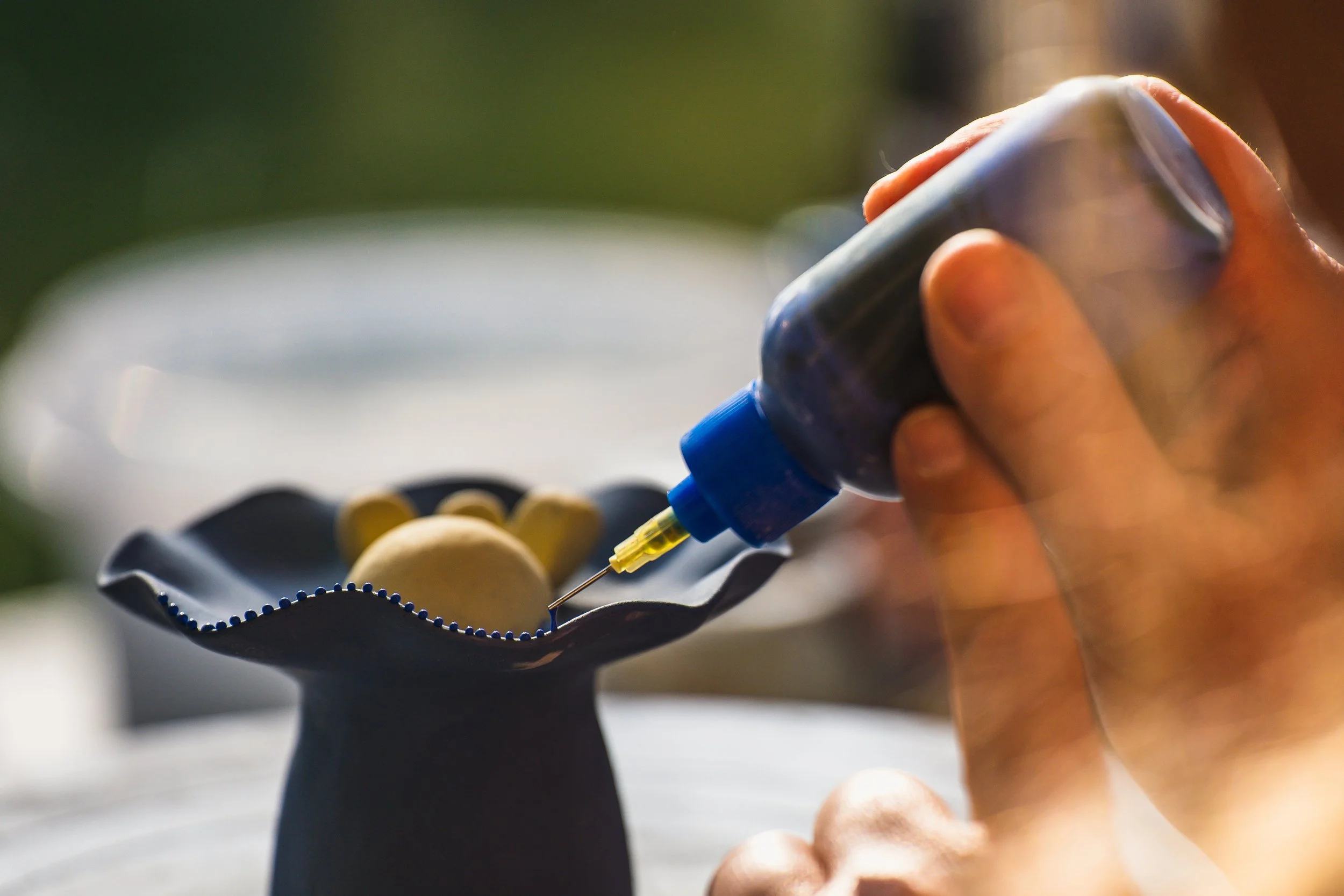
In the studio, this requires a particular kind of discipline. Forms are built by hand—pinched, coiled, layered. Surfaces are developed through repeated actions that accumulate over time. Glazes are applied with an understanding that they will move, break, crawl, or pool in ways that cannot be entirely controlled. The kiln completes the work, but it also introduces its own logic: heat, atmosphere, duration. What emerges is the result of a conversation between intention and response.
The threshold is not a fixed point, but a condition that is approached again and again.
Some works sit just at its edge. Others move further into it, where the reading of life becomes more insistent. Across a body of work, these shifts create a field—variations on a condition rather than a singular statement. The aim is not to arrive definitively, but to remain in that space of becoming.
This is where the work feels most alive.
Not because it is, but because it asks to be encountered as if it could be.