
On Scale, Attention, and the Value of Small Things
Scale shapes what we notice. This essay explores how working with small forms—lichen, moss, and fungi—reorients attention, inviting slower looking and revealing the complexity and value of often overlooked ecological systems.
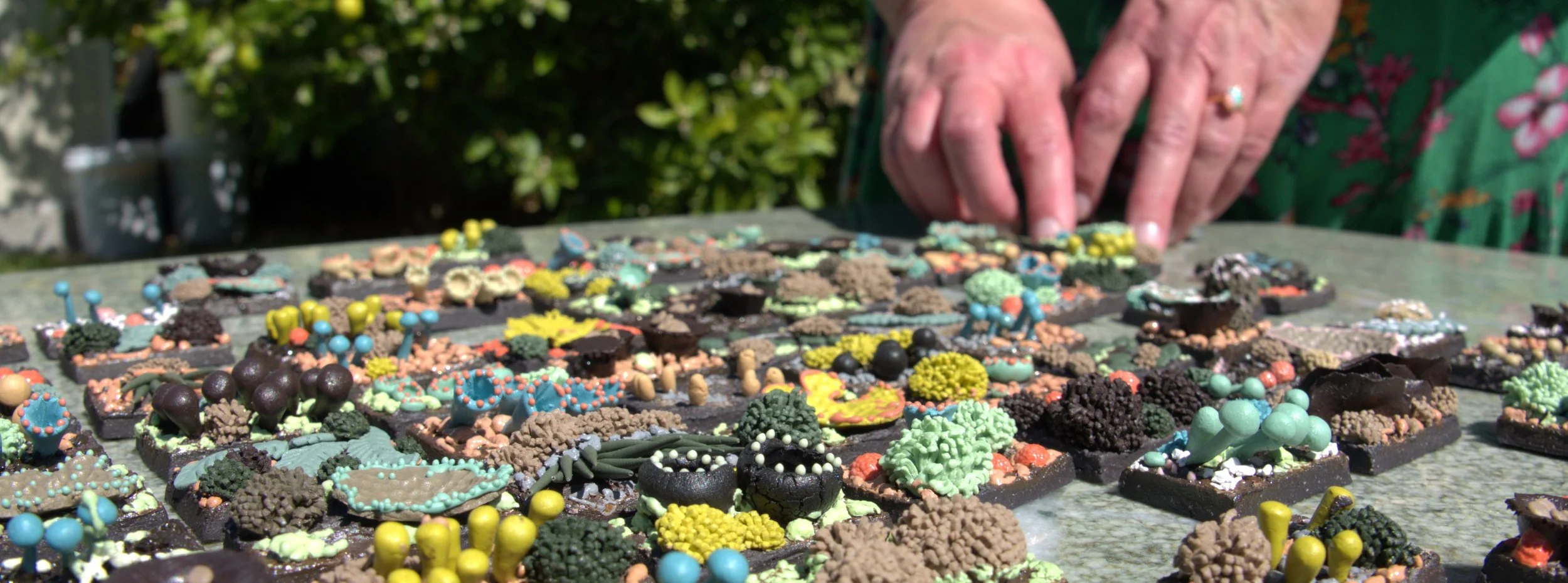
Forest Mini’s with Christie Lange
Scale shapes what we notice.
In contemporary culture, attention is often drawn toward what is large, immediate, and easily legible. Monumental forms, bold gestures, expansive views. These hold presence. They assert themselves.
But much of what sustains life operates at a different scale.
Lichens spread slowly across stone. Moss gathers moisture in quiet accumulations. Fungi emerge briefly, then disappear, their networks continuing unseen beneath the surface. Soil systems build incrementally, particle by particle, through processes that resist spectacle.
These forms do not compete for attention. They require it.
To encounter them fully demands a shift in pace. The body must slow. The eye must adjust. What first appears uniform begins to differentiate — colour, texture, structure, variation. Detail reveals itself gradually, and with it, complexity.
In this way, scale is not simply a physical attribute. It is a condition that shapes perception.
I am interested in what it means to work at this scale.
In the Forest Fragments series, each component is small — often no larger than a postage stamp. Within these constrained dimensions, I construct layered ceramic surfaces using stained porcelain, slip, and glaze. Lichen forms, moss structures, and fungal growths are built incrementally, often requiring close, repetitive gestures to develop density and variation.
The scale of the work resists quick reading. It asks the viewer to come closer.
This is not incidental. It is a way of structuring attention.
At a distance, the works appear quiet, contained. Up close, they reveal complexity — clustered growths, subtle shifts in colour, crawling glazes, small disruptions in surface. What is initially overlooked becomes active.
This movement — from distance to proximity, from assumption to observation — is central to the work.
It mirrors the way ecological systems are often encountered.
Much of what sustains an environment exists beyond immediate perception. It is easy to walk past a surface without recognising the communities it holds. Only through sustained attention do these systems become visible, and with visibility comes a different kind of awareness.
In this sense, smallness is not limitation. It is a strategy.
To work at a reduced scale is to resist spectacle. It is to refuse the assumption that significance must be large to be meaningful. Instead, it positions value within detail, within accumulation, within what is easily overlooked.
There is also an intimacy to this scale.
The body adjusts differently. The viewer leans in. The distance between eye and object closes. This proximity alters the relationship between the work and the viewer. It becomes less about viewing and more about encountering.
Time shifts in this space.
Looking slows. The impulse to move on is interrupted. Attention is held not through impact, but through sustained engagement. The work does not reveal itself immediately. It requires duration.
This is increasingly important.
In an environment saturated with images, where attention is fragmented and rapidly redirected, the capacity to look closely is diminished. Work that operates at a slower register offers an alternative. Not as opposition, but as invitation.
To say: remain here a little longer.
There is an ethical dimension to this.
Attention is not neutral. What we notice, and what we overlook, shapes how we understand the world. When small systems remain unseen, they are more easily disregarded. When they are brought into focus, their presence becomes harder to ignore.
In my practice, this is not about representation alone. It is about reorienting perception.
To make visible the organisms and systems that exist at the edges of awareness is to suggest that they matter. That their scale does not diminish their significance. That they are part of the structures that sustain larger environments.
This extends beyond subject matter into process.
Working at this scale requires a particular kind of attention. Repetition, patience, and a willingness to remain with small gestures over extended periods. Progress is incremental. Change is subtle. There are no shortcuts without loss of complexity.
In this way, the making mirrors the subject.
Both operate through accumulation. Both depend on time. Both resist acceleration.
There is a discipline in this, but also a form of alignment.
The scale of the work, the subject it engages, and the process through which it is made begin to correspond. Each reinforces the other. The work is not simply about small systems — it is constructed through a methodology that reflects them.
This relationship matters.
When scale, subject, and process align, the work holds together with greater clarity. It is not illustrating an idea; it is enacting it.
This has implications for how value is understood.
In many contexts, value is associated with size, speed, or visibility. Larger works command space. Faster production increases output. Visibility generates recognition.
But these metrics do not account for the kinds of systems I am interested in.
Lichens do not grow quickly. Moss does not expand through force. Soil does not accumulate in a single event. Their value lies in persistence, in quiet contribution, in the way small actions compound over time.
To work in response to these systems is to reconsider how value is measured.
Not in terms of scale or immediacy, but in terms of depth, attention, and the capacity to hold complexity within a limited space.
This is not a rejection of larger forms or broader gestures. It is a rebalancing.
To acknowledge that significance can reside in what is small. That attention can be directed rather than captured. That what is easily overlooked may, in fact, be foundational.
Scale, then, becomes a tool.
Not only for shaping objects, but for shaping perception.
To work at a small scale is to invite a different kind of looking. To ask for proximity, for patience, for care. It is to create conditions in which attention can settle.
And in that settling, something shifts.
What was once peripheral becomes central. What was once unnoticed becomes visible. What was once dismissed as minor reveals itself as complex, active, and essential.
In this way, scale is not simply a matter of size.
It is a way of directing attention toward what matters.