
Sustaining Practice: On Renewal, Rhythm, and the Artist’s Life
At what point does a practice stop being sustained by effort alone, and begin to require something else? This essay explores renewal, rhythm, and the conditions that allow an artistic practice to continue over time.
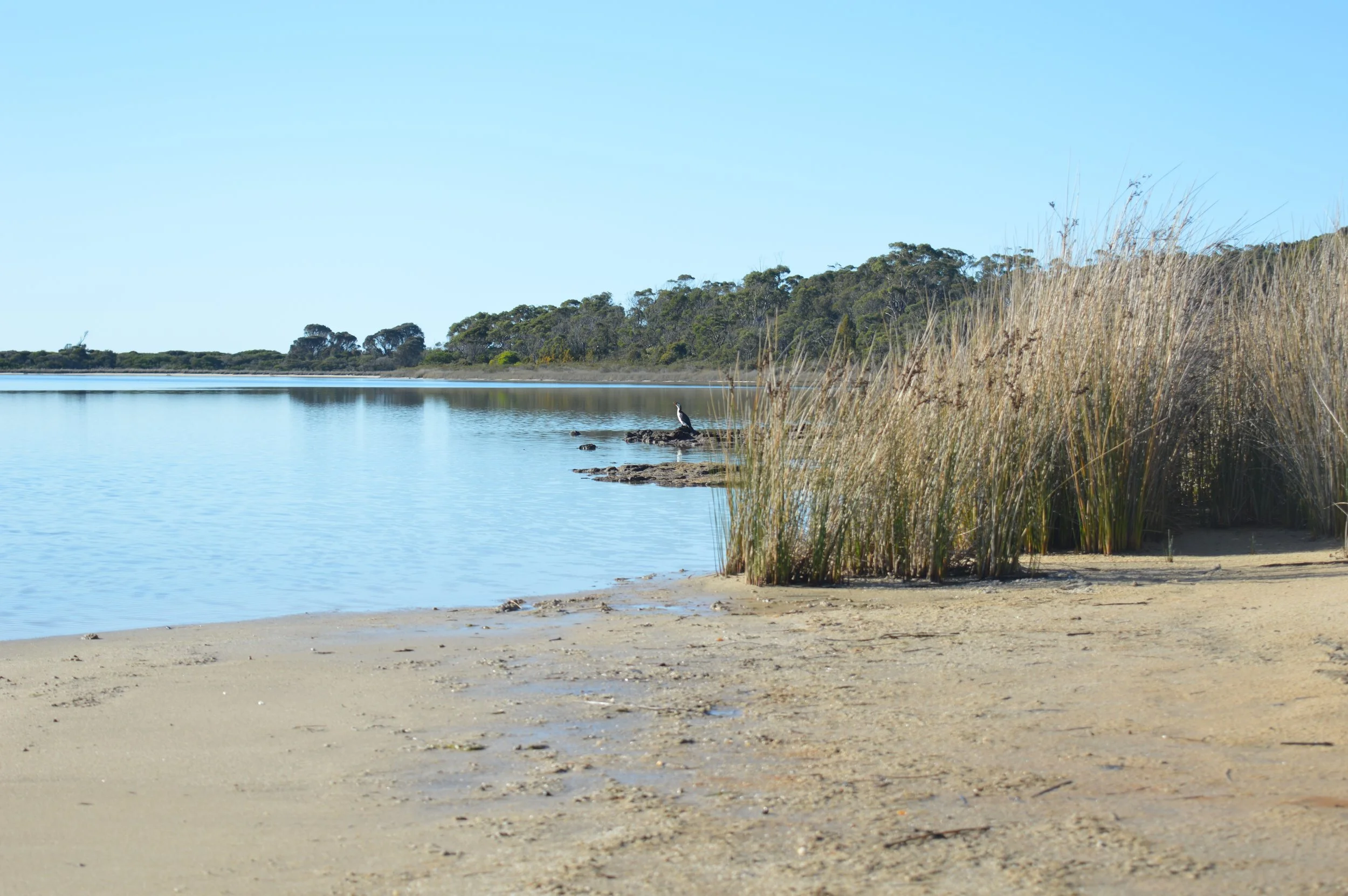
Cormorant on Grant’s Lagoon, Binalong Bay, Tasmania.
At what point does a practice stop being sustained by effort alone and begin to require something else?
There is a stage in making where momentum carries you. Work builds quickly, ideas arrive in succession, and the studio hums with a kind of forward pull. It can feel as though the practice is self-generating - fed by curiosity, urgency, or the desire to realise what is forming in the mind.
Over time, this begins to change.
Not abruptly, but gradually. I have felt this shift in my own practice—the pace of production, the weight of decisions, the accumulation of works, expectations, and commitments beginning to ask more of me than energy alone can provide. What once moved through force begins to require structure. What once felt driven by intensity begins to depend on something quieter.
Continuity.
A practice that continues is not held together by effort, but by rhythm.
In the natural systems I return to—lichens spreading slowly across stone, mosses thickening over seasons, fungal networks extending beneath the surface—growth does not occur through bursts of intensity alone. It is sustained through cycles: periods of expansion, followed by consolidation; moments of activity, followed by rest.
Nothing in these systems is separate from the conditions that allow them to continue.
Moisture. Light. Temperature. Time.
Remove one, and the system begins to shift. Remove several, and it collapses.
In the studio, it is easy to imagine that the work exists independently of these conditions—that it is something produced through will, discipline, or skill alone. Over time, however, it becomes clear that the practice is not separate from the person sustaining it. I have come to understand this not as an idea, but as something felt—physically, mentally, over the duration of making.
The body that returns to the studio each day.
The mind that holds and releases ideas.
The attention that shapes, refines, and recognises when something is complete.
These, too, require conditions.
Energy. Space. Rest. Renewal.
Without them, the work does not stop immediately—but it changes. It becomes thinner, more forced, less responsive. The dialogue between material and maker begins to narrow.
What is lost is not output, but vitality.
To sustain a practice over time is not to maintain constant productivity, but to create the conditions under which the work can continue to evolve.
This requires a shift in how the practice is understood: not as a series of outputs, but as a living system—one that moves through phases, that requires periods of apparent stillness, and that cannot be pushed indefinitely without consequence.
Within this, renewal is not an interruption to the work. It is part of its structure.
Time away from the studio allows new ideas to settle. Slower days, where observation replaces production, return attention to the world beyond the work. Moments of walking, noticing, and loosening the mind’s hold on outcome are not separate from the practice—they are what allow it to continue.
For me, renewal takes many forms.
It is found in reading, in watching films and series—sometimes for rest, sometimes drawn to themes that quietly echo the work. In music that alters the atmosphere of a day. In conversations with my partner, where ideas are spoken aloud and begin to take shape. In shared meals with friends, where the rhythm of life expands beyond the studio.
It is also found in time alone—artist dates spent wandering, looking, listening. Moving without outcome. Allowing attention to return to the world, and to be filled again.
And always, it returns to writing.
Journaling has been a constant throughout my life. A place to think through the process of writing, where the pen moves without censorship and words unfold in a continuous line—ink onto paper, thought into form. They reveal themselves to my eyes as if for the first time, offering a quiet illumination of my inner world.
Some of these reflections find their way outward—shared, shaped, and gathered over time—but most remain part of a quieter, ongoing dialogue.
It is a practice of noticing.
One that shapes not only the work, but the person making it.
And in that sense, it is not separate from the studio at all.
It is part of the same system.
There is a quiet discipline in recognising when to move forward, and when to pause.
It asks for an attentiveness to the work as it shifts—an ability to sense when something is still alive, still responsive, still offering something back. In those moments, the task is not to hurry, but to remain with it long enough for it to fully unfold.
But this sensitivity must extend in the other direction as well. There comes a point where that vitality begins to settle—where decisions feel familiar, where gestures repeat themselves without necessity, and the work begins to resolve too quickly, too easily.
It is often here that the impulse is to continue—to push forward, to produce more, to extend what is already known. And yet this is precisely where a different kind of awareness is required.
To step back at this moment is not to abandon the work, but to protect it—to prevent it from becoming fixed too soon, and to allow what has emerged to remain open rather than being overworked into certainty.
This requires a tolerance for uncertainty that is not always comfortable. A willingness to leave something unresolved, to resist the urge for immediate clarity, and to trust that the work is still active even when nothing visible is being made.
In this quieter space, things continue to shift. Ideas settle, connections form, and direction reorients itself—often without announcement.
What appears as stillness is not absence, but a different kind of movement.
This is not a loss of momentum.
It is a recalibration of it.
A movement that is less visible, but more precise.
A form of control exercised not through force, but through attention—through knowing when to continue, when to stop, and recognising that both are necessary to the life of the work.
Over time, the measure of a practice shifts.
It is no longer defined by how much can be produced, but by whether it can be sustained—whether it can hold depth without collapse, adapt without losing its core, and continue, year after year, without exhausting the person who carries it.
In this way, I am not separate from the system I am building.
I am part of it.
Subject to the same conditions. Dependent on the same cycles of use and renewal. Responsible for maintaining the balance that allows it to endure.
A practice that can continue is not driven by intensity alone.
It is shaped by attention, structured by rhythm, and sustained through renewal.
It is not built in a single surge, but over time—through repeated returns, careful adjustments, and an ongoing sensitivity to what is required.
Not just by the work.
But by the life that surrounds it—
and the life I am continuously learning how to sustain alongside it.