
On Renewal in Practice
Renewal is what allows something living to continue. This field note reflects on how renewal operates within creative practice — not as retreat, but as a condition for sustaining attention, material sensitivity, and the work itself over time.
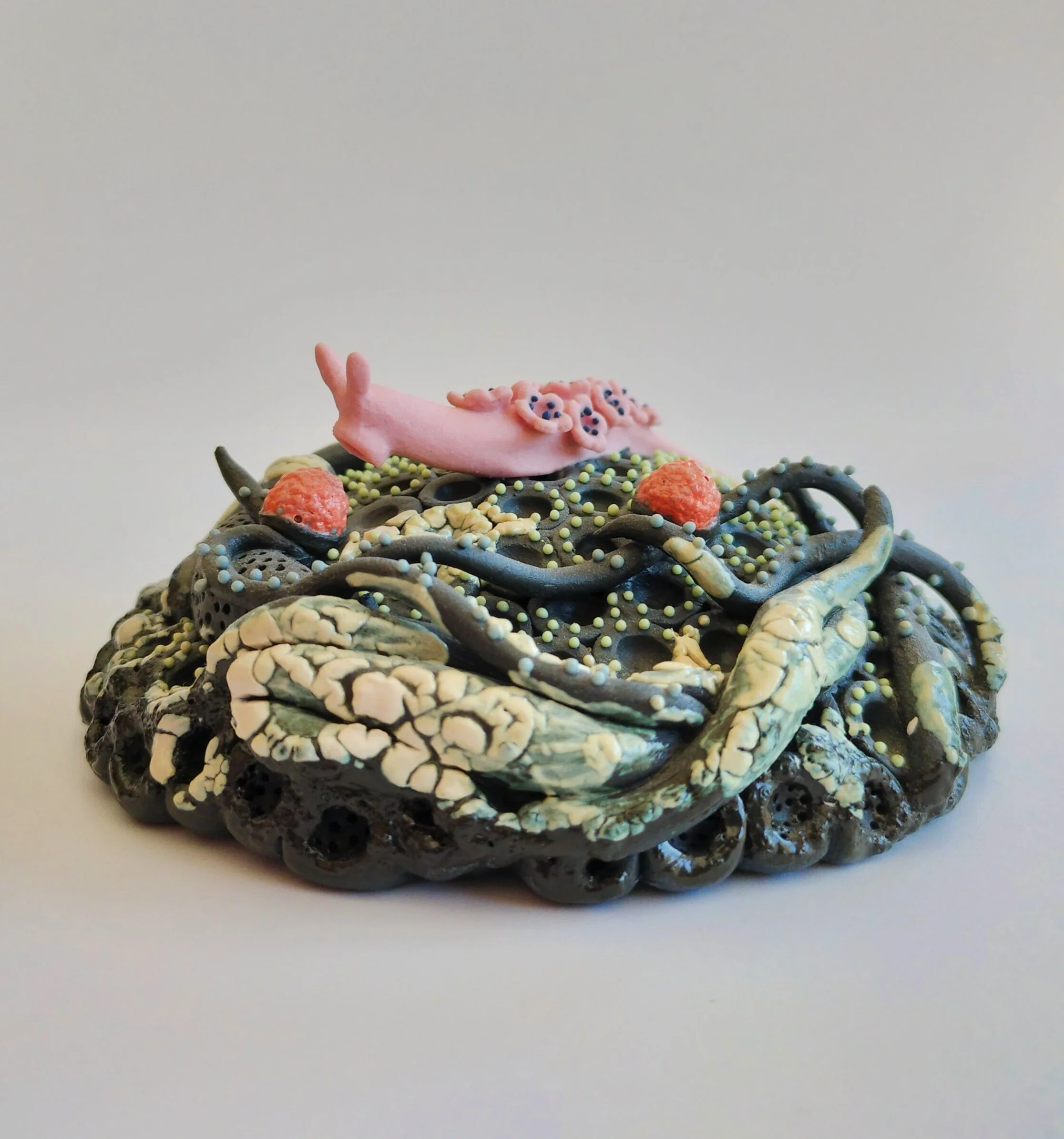
Gastropoda florilegia, 2023.
Renewal is what allows something living to continue.
I have been thinking about this not only in relation to ecological systems, but in relation to practice — and to the conditions required to sustain it over time.
In the studio, there is a tendency to measure output. What is made. What is finished. What is ready to be shown. But less often do I consider what allows the work to continue at all. Not just for a week or a season, but across years.
Clay makes this visible in quiet ways. It cannot be rushed indefinitely. It dries, stiffens, cracks if pushed beyond its capacity. It requires intervals — time to rest, to be wrapped, to regain moisture, to return to a workable state. These pauses are not interruptions to the process. They are part of it.
I am beginning to understand that a practice requires similar conditions.
Without renewal, there is a gradual narrowing. Attention thins. Decisions become reactive rather than considered. The work may continue outwardly, but something within it begins to diminish.
In ecological systems, renewal is rarely dramatic. It is cyclical, often slow, and frequently unnoticed. Moss gathers moisture over time. Lichens extend across surfaces in increments so small they are easily overlooked. Soil rebuilds through accumulation rather than event.
These systems do not operate through constant output. They operate through balance — periods of activity and periods of restoration, each necessary for the other.
I am interested in what it might mean to structure a practice in a similar way.
Not as withdrawal, and not as indulgence, but as maintenance of capacity. To recognise when attention is fatigued. To allow time for observation without immediate translation into work. To step back before the work begins to repeat itself without depth.
This extends beyond the making itself. It includes how time is held, what is agreed to, what is declined. It includes the pace at which ideas are developed, and whether they are given enough space to fully emerge.
There is also a material dimension to this. The choices made in the studio — how clay is used, how water is managed, how firings are approached — are part of a broader system. To work without consideration of these impacts is another form of depletion, even if it is less visible.
I do not yet have a fixed structure for this. It is something I am observing as it unfolds.
But I am beginning to recognise that renewal is not separate from practice. It is what allows it to continue.
Not as constant production, but as something sustained, responsive, and able to change.