
On Consolidation: Choosing Depth Over Noise
An essay on accountability, archive, and restoration in my art practice.
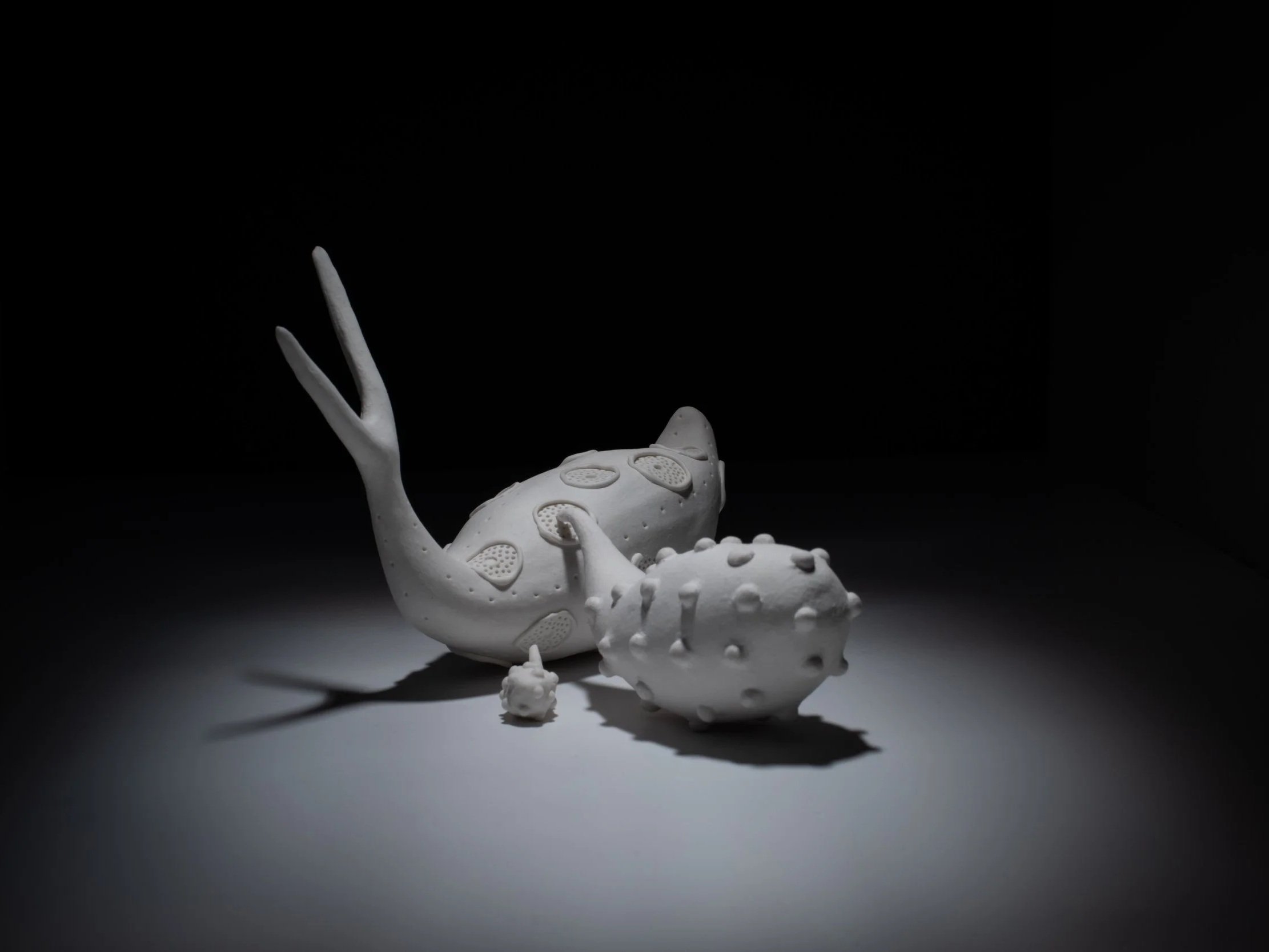
Family, 2019. Three white porcelain sculptures, sharing a moment. (Photo credit: Sonja Ambrose)
There comes a point in art practice where expansion no longer feels like growth.
For many years I made with curiosity and instinct — following forms that intrigued me, responding to landscapes that moved me. Over time, however, I began to recognise a quieter pull: not toward more work, but toward deeper work. Toward refinement. Toward consolidation.
Making carries ecological cost. Porcelain, glaze minerals, electricity, fabric — none of it exists outside systems of extraction. I do not stand apart from those systems. I participate in them. Rather than deny that reality, I choose to work with accountability — refining my process, reducing excess, and orienting the practice toward restoration and renewal wherever possible.
This shift has changed the pace of my studio.
I am less interested in producing volume and more interested in building an archive. An archive is not accumulation for its own sake; it is a record of sustained inquiry. It traces the deepening of attention over time.
My work centres on organisms that are easily overlooked — fungi, bryophytes, lichens, soil communities, and vulnerable marine ecologies. These life forms do not dominate their environments; they sustain them. They recycle and rebuild what falls. They regulate moisture, exchange nutrients, stabilise soil, buffer coastlines. Their strength lies in interdependence rather than expansion.
In observing these systems, I began to question the rhythm of my own making.
What would it mean to work as ecosystems work — with restraint, with attentiveness, with a commitment to repair rather than excess?
The Urchin Series marked one moment of this deepening. After reading extensively about the spread of Centrostephanus rodgersii along Tasmania’s east coast, watching the ‘White Rock’ documentary created by the Great Southern Reef Foundation, speaking with scientists and fishermen, and witnessing the ecological consequences firsthand, I felt compelled to respond materially. That body of work was not a stylistic pivot, but a focused investigation — a chapter within a broader inquiry into fragility and imbalance.
Other series have emerged from similar sustained observation. Each body of work now develops slowly, over extended periods, grounded in research and field experience. The archive grows not by expansion, but by concentration.
Consolidation, for me, is not retreat. It is commitment.
It is the decision to make fewer works, but stronger ones. To test materials more rigorously. To reuse clay, to refine glazes, to source reclaimed textiles, to pack kilns consciously. To acknowledge that making is never neutral — and to lean, where possible, toward restoration rather than depletion.
This does not mean perfection. It means attention.
Hope, for me, lives in that attention.
The organisms that inspire my practice do not transform ecosystems overnight. They operate incrementally — rebuilding soil particle by particle, forming symbiotic networks thread by thread. Their labour is slow, relational, and enduring.
I am interested in whether art can operate in a similar way.
Not as solution, but as witness. Not as spectacle, but as steadiness. Not as protest alone, but as participation in repair.
This phase of my practice marks a conscious turning point — a consolidation of inquiry, material discipline, and ethical orientation. It is a commitment to remain with the work long enough for it to deepen.
The archive I am building is not only a record of forms; it is a record of attention.
And attention is where restoration begins.
CHRISTIE LANGE
Next Essay: In Dialogue with Clay

Beneath the Spines, 2025. Finalist: 2025 Southern Ocean Art Prize. Flat lay photograph of nine black clay sea urchin sculptures with white porcelain teeth.
Photo Credit: Angela Casey.